
Why Does it Feel Like the World is Falling Apart?
And now the masses are attracted to totalitarianism

This piece was heavily inspired by the book Belonging Again written by my good friends and multi podcast guests O.G. Rose. I can’t recommend their work enough.
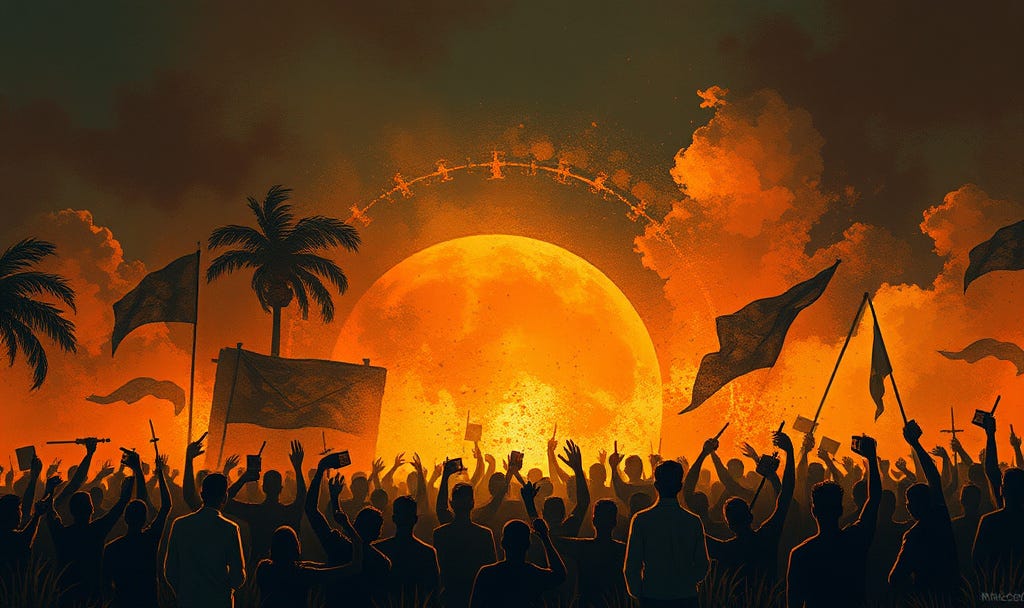
Something is wrong and you can feel it.
Wrong in the way that every choice you make feels both completely free and completely arbitrary.
You can be anyone. Do anything. Live anywhere. Believe whatever you want.
And yet.
You’ve never felt more lost.
The Loss of “Givens”
There was a time - not that long ago - when most of life’s major questions were answered before you could ask them.
Where would you live? Where your family lived. What would you do for work? What your father did, or what the local economy offered. What would you believe? What your community believed. Who would you marry? Someone from your village, your church, your social class.
These weren’t choices. They were givens.
You didn’t decide your identity. You inherited it. You didn’t construct your worldview. You received it. The path was narrow, yes - but it was a path. You knew where you stood.
Today, our identities, religions, nationalities, occupations, life choices, philosophies, political ideologies - all have ceased to feel legitimate to us. None of them are “given” anymore. Whatever we face, we find ourselves full of questions: Is this true? Is this best? Is this valid?
Nothing feels given now. When we attend religious services, we feel anxious. When we accept atheism, we wonder what else is out there. When we live in one town versus another, we feel uncertain if we made the right choice. When we become a banker instead of an entrepreneur, we wonder if we’re wasting our potential.
Able to do anything and be anyone, all choices feel equally valid and equally arbitrary - even those that might not be arbitrary at all.
The Legitimation Crisis
In 1973, the philosopher Jürgen Habermas published a prophetic book called The Legitimation Crisis. It warned that we were losing confidence in political institutions, rendering those institutions ineffective and profoundly damaging democratic processes.
Forty years later, his diagnosis has spread far beyond politics.
Today, the “legitimation crisis” applies to nearly everything in modern life. We don’t trust our experts, even when they’re telling the truth. We don’t trust our politicians, believing they’re in it for themselves. We don’t trust our professors, believing they’re ideologically driven. We don’t trust our bankers, believing they’re driven by profit.
And we don’t trust our own decisions, never certain they’re right.
We don’t trust ourselves.
The traditional definitions of reality that previously provided stable guides for living everyday life - in courtship, marriage, child-rearing, religious faith and practice - are increasingly fluid, fragmented, and deprived of plausibility.
This isn’t paranoia. It’s the logical result of living in a world where nothing is “given” anymore. Once you realize that any “given” could be optional, it by definition cannot be a “given.” There’s no way to keep the bar low enough to ever trust it again.
Pluralism undermines all certainties.
The Paradox of Freedom
Here’s what no one told you about freedom:
Choice has increased while direction has decreased.
We have more options than any humans in history. More careers. More lifestyles. More belief systems. More places to live. More ways to spend our time. More potential identities to try on.
And yet we’re drowning.
As thinkers like Erich Fromm, Peter Berger, and Philip Rieff warned decades ago: under conditions of incredible freedom, humans are likely to become existentially and psychologically anxious. The freedom of choice is increasing, which makes life both easier and harder to handle - generally easier on the physical side, harder on the mental.
Under conditions of incredible freedom, humans are likely to become existentially and psychologically anxious.
Relativism liberates, but the resulting liberty can be quite painful; people then seek liberation from relativism.
We must make ourselves now. We become the sum of a collection of choices that don’t feel “given.” Today, blessed with options, we certainly have a great measure of freedom - but by the same token, we have lost our old capacity for certitude.
The existential wondering comes with responsibility. And it can never be entirely silenced. Because we’re not omniscient. We can never know for sure if we made the best choice.
We are all condemned to be existentialists now.
Pluralism Doesn’t Just Happen Outside You
Here’s what makes this truly inescapable:
Cultural plurality is experienced by the individual not just as something external - all those people with different beliefs you bump into - but as an internal reality, a set of options present in your own mind.
Pluralism doesn’t just happen outside of us. It happens in us.
We are internally freer. But if we want to escape from that freedom, we are not free.
If you were forced to live in a small town twenty years ago, you might have wrestled with feelings of being trapped. But you were unlikely to wrestle with feelings of whether you “made the right choice” - because you didn’t feel responsible for where you were forced to live.
Now you’re responsible for everything. Where you live. What you do. What you believe. Who you are.
And because you’re responsible, you can never stop wondering if you chose correctly.
Put simply, on the level of human consciousness, modernization is a movement from fate to choice - from a world of iron necessity to one of dizzying possibilities. This can truthfully be described as a great liberation. But one must also understand the discontents and even terrors that can come with it.
The Hidden Engine of Extremism
Now we arrive at the part no one wants to say out loud.
This explains what’s happening to us.
The rise of extremism. The tribalism. The desperate clinging to ideologies. The appeal of strongmen and authoritarian movements. The way people retreat into ever-narrower identity groups and refuse to engage with anyone outside them.
These aren’t moral failures. They’re predictable responses to unbearable anxiety.
When nothing feels “given,” when every choice feels arbitrary, when you can never be certain you’re living the right life - the weight becomes too much. And people will do almost anything to escape it.
With increased freedom can come the increased appeal of escaping freedom.
Totalitarianism becomes appealing not despite our freedom, but because of it. When certainty is lacking, existential stability wanes. And people will trade their freedom for the relief of having someone else tell them what to do, what to believe, who to be.
This isn’t weakness. It’s human nature responding to an impossible situation.
If extreme candidates succeed in elections around the world, suddenly the “legitimacy” of Western society is thrown into question. The trance of belief in society is broken. Events like Brexit, Trump, the rise of China - these cause a destabilization of our worldviews, which creates existential anxiety, which makes totalitarianism appealing.
We are watching this happen in real time.
The Fork in the Road
So here we are. Standing at a fork.
On one side: escape freedom. Flee into ideologies, tribes, systems that do the thinking for you. Let someone else carry the weight of deciding what’s true, what’s right, who you are. Feel the relief of certainty - even if it’s manufactured, even if it requires you to stop thinking.
On the other side: face freedom. Do the hard cognitive and emotional labor of living with uncertainty. Hold the anxiety instead of running from it. Accept that you’ll never be certain you made the right choices. Build the capacity to live in a world with many competing value systems, none of them “given.”
There is no third option.
You cannot go back to a world of “givens.” That world is gone. Even if you try to reconstruct it - through fundamentalism, through ideology, through sheer force of will - you’ll always know, somewhere, that you chose it. And a chosen certainty is not the same as an inherited one.
For those who have drunk from the fountain of modern relativism, there does not appear to be a way back.
And all of us have drunk.
The Only Security Available
Here’s the reframe that changes everything:
Security isn’t the absence of anxiety. Security is the capacity to stand confidently before what is difficult, terrifying, and anxiety-producing.
When we protect ourselves with false certainties - with realism, with ideology, with tribalism - we can look secure. But we’re not. Our security is dependent on our environment. It’s contingent. It’s weak.
And the indirect desire to delete anxiety, rather than face it, ultimately creates more anxiety when the effort proves fruitless. Because anxiety, in a world without “givens,” is undeletable. Its possibility will always be with us.
The goal isn’t to solve the anxiety. It’s to build the muscle to hold it.
Even if you happen to choose “the best of all possible lives” - the most rational, the most pleasurable - you can never know for sure that you have. If you happen to live according to the truest religion, you can never totally know you do so. If you ascribe to the right politics, there will still be room for doubt.
Life is always married to the possibility of existential anxiety.
The question is whether you’ll run from that marriage or learn to live in it.
The Labor Required
I won’t pretend this is easy.
The path of facing freedom requires genuine labor - cognitive, emotional, spiritual. It requires developing “radical openness”: the willingness to receive whatever reality presents us with, even when it contradicts our preferences.
It requires holding our beliefs with an open hand. Keeping what we need to function without letting our certainties become oppressive forces - to others or to ourselves.
It requires directing our criticism toward our own assumptions rather than toward anyone who doesn’t align with them.
It requires accepting that we can be practically committed to our beliefs - living them fully, defending them vigorously - while simultaneously acknowledging we might be wrong.
This is not comfortable. Comfort comes from certainty. And certainty, in the modern world, is either inherited (rare), manufactured (dangerous), or earned through the slow work of confronting reality directly (hard).
Most people won’t do this work. That’s not a judgment. It’s a recognition of how difficult it is.
But for those who do - for those willing to sit with the uncertainty instead of fleeing from it - there’s something waiting on the other side.
Not certainty. Not the return of “givens.” Not the erasure of anxiety.
Something better.
The capacity to belong in a world where belonging isn’t given. The ability to commit to a path while knowing you could be wrong. The freedom to hold your identity lightly without losing yourself entirely.
Real security. The kind that doesn’t depend on the world cooperating with your beliefs.
The Choice Before You
So.
You feel lost. Anxious. Uncertain about everything. Unable to trust institutions, experts, or even your own judgment. Paralyzed by options. Haunted by the sense that nothing is real.
This is not a personal failure.
This is the condition of modern life. The price of freedom. The inheritance of everyone born after ~1960s.
You have two choices:
Find something to believe in so hard that you forget you chose it. Join a tribe. Adopt an ideology. Let someone else do your thinking. Feel the relief. Pay the cost later.
Learn to hold the uncertainty. Build the cognitive and emotional muscles to live in a world without a script. Do the labor. Face the anxiety. Develop real security - the kind that comes from capacity, not circumstances.
The first path is easier. The second path is better.
No one can make this choice for you.
That’s the whole point.
Again this essay draws heavily on O.G. Rose’s “Belonging Again,” a philosophical exploration of legitimation, pluralism, and the search for meaning in a post-given world. I highly recommend signing up to their substack O.G. Rose